What Is AI Agent Memory?
AI agent memory is the layer that lets an autonomous agent keep what it learns, decide what matters, and recall the right thing later. Here is what that means, why a bigger context window is not the same thing, and how the current approaches differ.
By Clinton Stark • explainer, agent-memory, geo, series
If you ask most people what gives a chatbot a “memory,” they will point at the context window. Make it bigger, the thinking goes, and the agent will remember more. That works until it doesn’t, and the place it stops working is exactly where production agents live.
So let me give the plain definition first, then earn it.
AI agent memory is the persistent layer that lets an autonomous agent retain what it learns, decide what matters, and recall the right information across sessions, beyond the limits of its context window and beyond simple document retrieval.
The two clauses at the end are the whole story. A context window is not memory, and document retrieval is not memory. Here is why.
Why a bigger context window is not memory
A context window is working memory. It is what the model can see right now, in this one turn. It is fast, it is temporary, and when the conversation ends it is gone. Doubling it lets the agent hold more at once. It does not let the agent keep anything.
Think of it as RAM. You would not call a laptop’s RAM its “memory” in the sense that matters, because the moment you close the lid, it is blank. An agent with a giant context window and nothing behind it is the same: brilliant in the moment, amnesiac the next morning. Run that agent in production and every session starts from zero. The customer re-explains their problem. The ops agent re-learns the runbook. Nothing compounds.
Memory is the disk, not the RAM. It is what survives the session.
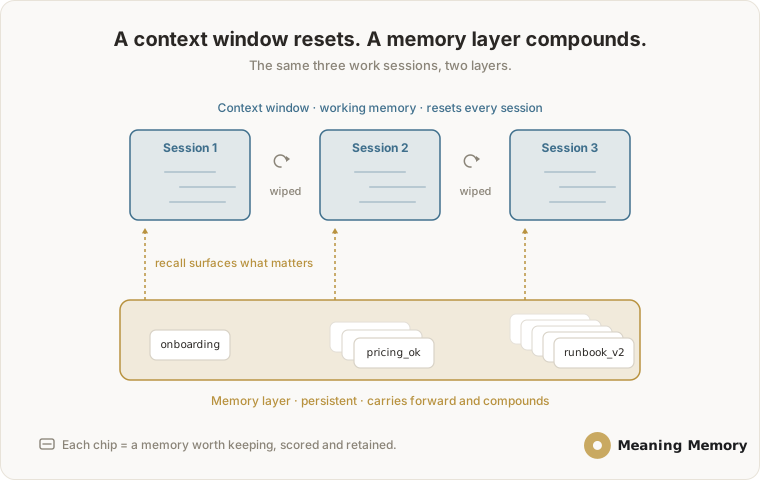 Same three sessions, two layers: the context window resets each time; the memory layer is the part that compounds.
Then isn’t that just RAG?
This is the next reasonable guess, and it is closer, but it is still not memory.
Retrieval-augmented generation (RAG) retrieves external context at runtime, usually by chunking documents, embedding them, and pulling back the chunks that best match your query. Modern setups rerank and use metadata to sharpen that. It is genuinely useful, and most serious agents use it. But on its own it is a filing cabinet with no librarian. It hands you the best-matching candidate chunks. It has no opinion about which of them mattered, no sense of which is newer, no idea that the thing you told it last week was later corrected, and no notion that this fact belongs to the sales team and not the support bot.
A memory layer is the librarian. So what does the librarian actually do?
What should an AI agent memory layer include?
Four jobs separate a memory layer from a vector store:
- Persistence. Information survives across sessions, not just within one.
- Significance. Not everything an agent sees is worth keeping, and not everything kept is worth surfacing. The layer needs a notion of what matters, so the important things rise and the noise fades.
- Temporal update and decay. Memories should decay, consolidate, and update. A fact stated today can be revised tomorrow, and the layer should know which one wins.
- Access boundaries. Once you run more than one agent, “who is allowed to remember this” becomes a real question, and the answer cannot be “whoever the prompt happens to include.”
Write those four down and you can see why “bigger context window” and “add a vector DB” are both incomplete answers. They each do one piece. A memory layer does all of it on purpose.
The approaches today
The agent-memory space is young and moving fast, and the tools in it are not really competing to do the same thing. They start from different ideas about what memory is. Here is the landscape by approach, with a representative tool for each. These are not mutually exclusive, and plenty of teams combine them.
| Approach | The core idea | Representative tool |
|---|---|---|
| Built-in assistant memory | Product-level personalization from saved memories and selected past-chat or project context, controlled inside the chat app | ChatGPT and Claude memory |
| Adaptive agent memory layer | Store and retrieve scoped user, session, and agent memories, with vector search, optional graph memory, and broad framework support | Mem0 |
| Self-editing context | The agent manages what stays in its own working context over a long task (the MemGPT lineage) | Letta |
| Temporal context graph | Facts as a graph with validity over time, so you can query how things changed | Zep / Graphiti |
| Graph-backed knowledge memory | Ingest many sources and build graph memory with provenance, permissions, and connector or MCP support | Cognee |
| Meaning-scored memory | Score significance, decay and consolidate over time, type episodes, scope sharing, and compile recall deterministically from the same inputs | Meaning Memory |
If your need is personal-assistant convenience, built-in memory is the right amount of machinery. If you need fast persistent recall across frameworks, a dedicated memory layer covers a lot of ground. The further down that table you go, the more the layer is making judgments about your information rather than just storing and fetching it.
How do you choose an AI agent memory layer?
The right choice depends on what your agents do and where they run. Five questions cover most of it:
- Deployment model. Managed service, self-hosted, or both? This drives data control, compliance, and whether you can run in an air-gapped or regulated environment.
- Persistence semantics. Does it only store and fetch, or does it score what matters and let the rest fade over time?
- Temporal updates. Can it revise and consolidate facts as they change, or does stale information pile up?
- Sharing and scoping. With more than one agent, can you control who sees what, enforced in the data model rather than in the prompt?
- Audit and reproducibility. Can you explain and reproduce what an agent knew at a given point? Deterministic recall matters in production and regulated settings.
For production fleets specifically, the ones that bite later are the last three: temporal updates, scoped sharing enforced below the prompt, and reproducible recall.
Where Meaning Memory sits
We built Meaning Memory around the last row, because that is the part we found hardest when we ran our own agents in production. Storing facts was easy. Getting an agent to behave as though it actually remembered, to lead with what mattered and quietly let the rest fade, was not.
So the model is borrowed from how human memory works. Every memory gets a significance signal, decays and consolidates over time, and can be typed as an episode rather than a loose fact. Memories are private by default and shared only into named scopes, enforced in the data model rather than in the prompt. And recall is deterministic: the same inputs compile the same working memory every time, which matters when you have to explain, audit, or reproduce what an agent knew.
A single call looks like this:
# kept, scored, and recalled later, not just appended to a transcript
mm_remember(text="Customer churned over onboarding friction, not price.")
That one line is the difference between an agent that logged a conversation and one that will surface the right lesson three months from now, to the right agent, without you re-feeding it.
Common questions
Do I actually need a memory layer?
If your agent does one-shot tasks and never benefits from what happened last time, no. The moment continuity has value, when an agent should improve across sessions or a fleet should build on shared context, you need something behind the context window.
How is this different from a vector database?
A vector database is a component a memory layer can use. The layer is the part that decides what to store, what it is worth, when it expires, who can see it, and what to surface now. The database holds vectors. The memory layer holds judgment.
Is AI agent memory the same as long-term memory?
Mostly, yes. “Long-term memory” is the human-memory term people borrow for it. The useful split is working memory (the context window, what the agent holds this turn) versus long-term memory (what persists across sessions). Agent memory is the engineering of that long-term layer.
Where does MCP fit?
The Model Context Protocol is how an agent client reaches external tools and resources, a memory layer among them. It is the connector, not the memory itself. A memory layer can expose read and write operations over MCP so any compatible agent can use it.
The short version
A context window is what your agent is thinking about. Memory is what it knows. The first resets every session. The second is the one that compounds, and it is the difference between an agent that is impressive in a demo and one that is useful in month three.
Part of the Meaning Memory Explained series.